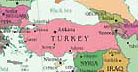
Borders of Turkey
The land borders of Turkey are 2,573 kilometres in total, and coastlines are another 8,333 kilometres, Turkey has two European and six Asian countries for neighbours along its land borders.
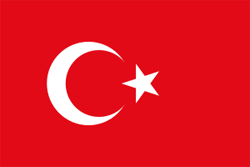
Conventional long form: Republic of Turkey
Conventional short form: Turkey
Local long form: Turkiye Cumhuriyeti
Local short form: Turkiye
Geographically, the country is located in the northern half of the hemisphere at a point that is about halfway between the equator and the north pole, at a longitude of 36 degrees N to 42 degrees N and a latitude of 26 degrees E to 45 degrees E. Turkey is roughly rectangular in shape and is 1,660 kilometers wide.
Because of its geographical location the mainland of Anatolia has always found favour throughout history, and is the birthplace of many great civilizations. It has also been prominent as a centre of commerce because of its land connections to three continents and the sea surrounding it on three sides.
The actual area of Turkey inclusive of its lakes, is 814,578 square kilometres, of which 790,200 are in Asia and 24,378 are located in Europe.
The land borders of Turkey are 2,573 kilometres in total, and coastlines are another 8,333 kilometres, Turkey has two European and six Asian countries for neighbours along its land borders.
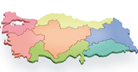
Turkey is divided into seven regions: the Black Sea region, the Marmara region, the Aegean, the Mediterranean, Central Anatolia, the East and Southeast Anatolia regions.
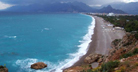
Turkey is surrounded by sea on three sides, by the Black Sea in the north, the Mediterranean in the south and the Aegean Sea in the west.
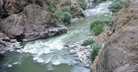
Most of the rivers of Turkey flow into the seas surrounding the country. The Euphrates Tigris join together in Iraq and flow into the Persian Gulf.
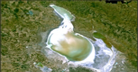
In terms of numbers of lakes, the Eastern Anatolian region is the richest. It contains Turkey's largest, Lake Van, and the lakes of Ercek, Cildir and Hazar.
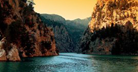
Although Turkey is situated in a geographical location where climatic conditions are quite temperate, the diverse nature of the landscape, and the existence in particular of the mountains that run parallel to the coasts, results in significant differences in climatic conditions from one region to the other.